





If you’ve ever cleaned a window that looked perfect while wet but developed streaks or white spots as it dried, the problem may not be your squeegee technique—it could be the water itself. Tap water contains dissolved minerals that can remain on glass as it evaporates, especially in hard-water areas.
Pure water window cleaning solves this by removing most dissolved solids before the water reaches the glass. Professional systems typically combine reverse osmosis (RO) with deionisation (DI) to produce very low-TDS water, allowing exterior windows to be cleaned and left to air-dry with minimal mineral residue.
This approach is particularly useful in Dubai, where dust, heat, and mineral-rich water can make exterior glass harder to maintain. That’s why professional window cleaning in Dubai increasingly uses purified water systems for a clearer, more consistent finish. Here’s how the process works and why it can outperform traditional soap-and-squeegee cleaning.
What Is Pure Water Window Cleaning?
Pure water window cleaning uses water that has been highly purified to remove dissolved minerals and other impurities before it is applied to the glass.
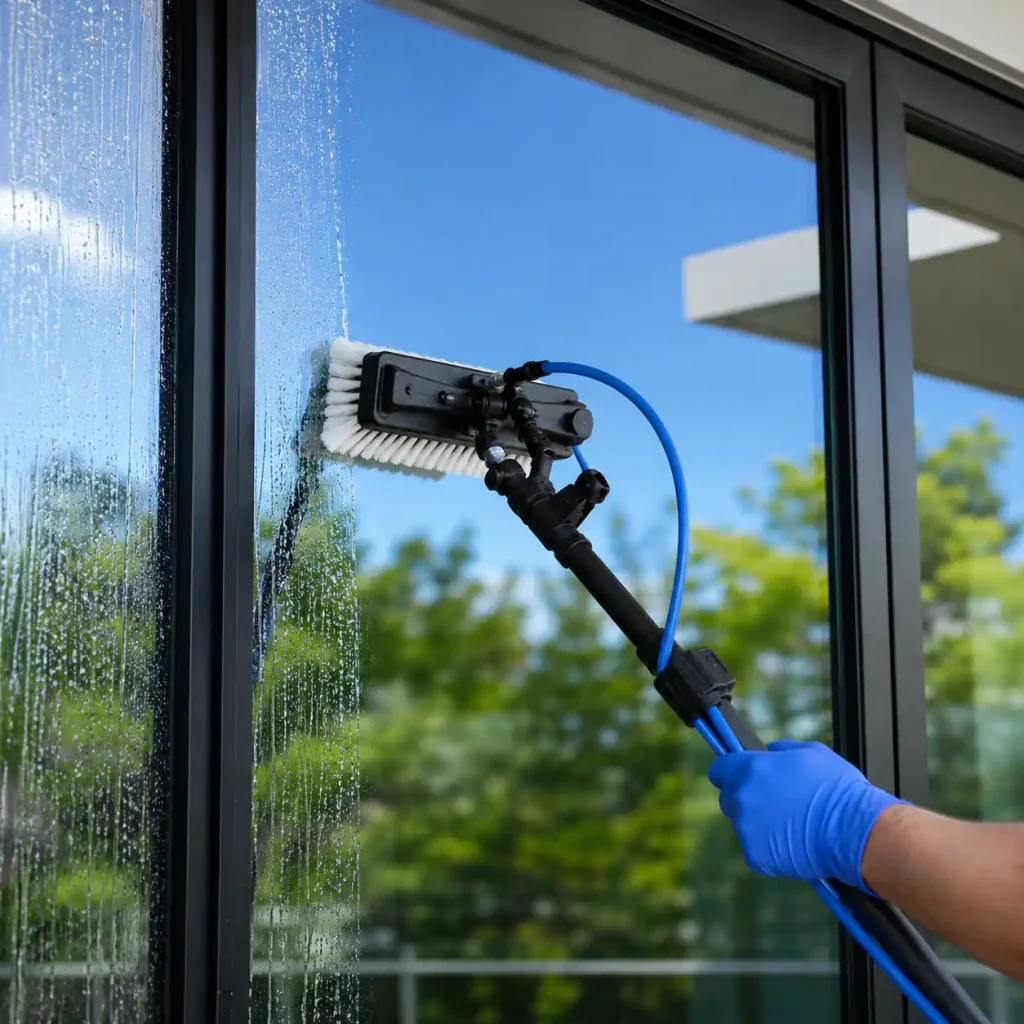
The purified water is usually delivered through a water-fed pole system. A brush at the end of the pole agitates the glass and surrounding frames, while the purified water rinses away loosened dirt. The final rinse is then left to dry naturally.
The key difference is what the water doesn’t contain.
Ordinary tap water contains dissolved minerals. Pure water has had those minerals reduced to a very low level, so there is far less mineral residue available to remain on the glass when the water evaporates.
This is why the method can produce a clean, spot-free finish without relying on detergent or manually drying every section of exterior glass.
How Reverse Osmosis Produces Cleaner Water
Reverse osmosis, commonly called RO, is one of the main stages used in professional water purification systems.
In simple terms, RO uses pressure to push water through a semi-permeable membrane. The membrane reduces a large proportion of dissolved salts, minerals, and other impurities from the incoming water. Depending on the system and water quality, RO can remove most of the total dissolved solids before the water moves to the next purification stage.
However, RO alone is not always the final stage used for professional window cleaning.
Many systems combine:
- Pre-filtration to protect the purification equipment
- Reverse osmosis to remove most dissolved solids
- Deionisation (DI) to remove remaining ions and reduce TDS even further
This RO/DI combination is what allows professional window cleaners to produce the very low-TDS water needed for reliable spot-free results.
So when you hear the term “RO water” in the window-cleaning industry, it is worth checking whether the system also uses DI purification.
Why TDS Matters for Window Cleaning
TDS stands for Total Dissolved Solids. It is a measurement of the dissolved substances present in water and is commonly expressed in parts per million (ppm).
For window cleaning, TDS matters because dissolved minerals can remain behind when water evaporates.
A professional cleaner can use a TDS meter to check the quality of the purified water before it reaches the glass. As the reading rises, the risk of mineral residue generally increases.
The exact acceptable reading depends on the equipment, water source, glass condition, and cleaning process. Rather than relying on a single universal number, professional operators should monitor their output water and maintain the purification system according to its specifications.
Very low-TDS water is desirable because it leaves significantly less dissolved material behind during evaporation.
How Pure Water Window Cleaning Works
The process is straightforward, although the purification equipment behind it requires proper maintenance.
1. Tap Water Enters the Purification System
The process starts with ordinary mains water. Depending on the system, the water passes through one or more pre-filters before reaching the RO membrane.
2. Reverse Osmosis Removes Most Dissolved Solids
The RO membrane reduces the concentration of dissolved minerals and other impurities in the incoming water.
3. Deionisation Further Purifies the Water
Where an RO/DI system is used, DI resin captures remaining charged ions, bringing the water’s TDS down to a very low level.
4. Purified Water Reaches the Window
The water is pumped through a hose and water-fed pole to a specialist brush.
5. The Brush Agitates Dirt and Grime
The brush loosens dust, dirt, pollen, and other surface contamination from the glass, frames, and sills.
6. The Glass Is Thoroughly Rinsed
The purified water carries away the loosened contamination.
7. The Window Air-Dries
Because the water contains very little dissolved mineral content, there is much less residue available to form spots as it evaporates.
Pure Water vs. Traditional Soap and Squeegee Cleaning
Both methods can produce good results when used correctly. The main difference is how they deal with water and residue.
| Factor | Pure Water Method | Soap & Squeegee |
| Cleaning agent | Purified water | Water + detergent |
| Final drying | Air-dried | Usually manually dried |
| Mineral spotting risk | Low when water is properly purified | Depends on water quality and technique |
| Exterior reach | Water-fed poles can reach elevated glass | May require ladders, poles, lifts, or other access |
| Chemical use | Usually no detergent required | Typically uses cleaning solution |
| Best suited to | Exterior maintenance and hard-to-reach glass | Interior glass and certain heavy-soiling situations |
Pure water doesn’t make traditional window cleaning obsolete. Squeegees remain highly effective, particularly for interior glass and situations where immediate drying is preferred.
The advantage of pure water becomes particularly noticeable when cleaning large areas of exterior glass where manually drying every pane would be slower or more difficult.
Why Pure Water Works Well for Window Cleaning in Dubai
Dubai presents several practical challenges for maintaining clear exterior glass.
Dust and sand can settle on windows quickly, while strong sunlight and high temperatures can accelerate evaporation. If ordinary water is left on glass, dissolved minerals can become visible as the water dries.
Professional pure water systems address one part of that problem by reducing the mineral content of the water before it reaches the glass.
This doesn’t mean purified water prevents dirt from returning. Dubai’s dust and outdoor exposure will still affect windows. However, removing mineral residue from the cleaning process can help produce a clearer finish and reduce one common cause of spotting.
This is one reason pure water technology is increasingly used for professional exterior and window cleaning services in Dubai. Local cleaning providers also market RO/DI or multi-stage purified water systems specifically for streak-free exterior glass.
Does Pure Water Cleaning Use Chemicals?
For the water-fed exterior cleaning process, detergent is generally not required.
The system relies on purified water and mechanical agitation from the brush to loosen and rinse away surface dirt.
That said, “chemical-free” should not be interpreted as meaning that every type of window cleaning job can always be completed without any cleaning solution. Heavy deposits, construction residue, adhesive, paint, or other contaminants may require a specialist treatment depending on the condition of the glass.
A professional cleaner should assess the surface before choosing the cleaning method rather than assuming pure water alone is appropriate for every situation.
Is Pure Water Safe for All Glass?
Pure water itself is generally suitable for routine exterior cleaning of many common glass surfaces, but the condition and type of glass still matter.
Tinted glass, coated glass, decorative glazing, older frames, and heavily contaminated surfaces may require additional care. The cleaning method should also account for the surrounding frames, seals, facade materials, and any existing damage.
For example, old or neglected windows may have contamination that becomes visible only after cleaning. Mineral deposits, deteriorated coatings, damaged seals, or residue around frames can sometimes affect the final appearance even when the water quality is excellent.
Pure water is therefore a cleaning method, not a guarantee that every pre-existing glass defect will disappear.
Can Pure Water Clean High Windows?
One of the biggest practical advantages of pure water window cleaning is the use of water-fed poles.
Telescopic poles allow trained cleaners to reach many elevated exterior windows from ground level, reducing the need for ladders on suitable buildings. The actual working height depends on the pole system, building design, water pressure, access conditions, and the cleaner’s equipment.
For taller buildings or windows that cannot be safely reached with water-fed poles, other access methods may be required, including rope access, cradles, or specialist lifting equipment.
The safest method should always be selected based on the building rather than simply the height of the window.
How Often Should Pure Water Window Cleaning Be Done?
There isn’t one cleaning schedule that works for every property.
In Dubai, exterior windows can accumulate dust and airborne particles relatively quickly, so homes and commercial properties with high exposure may need more frequent cleaning than properties in sheltered locations.
A practical maintenance schedule can range from every few weeks to every few months depending on:
- Exposure to dust and sand
- Property location
- Traffic and surrounding construction
- Coastal exposure
- Landscaping and irrigation
- Number and size of windows
- Desired appearance standard
For many residential properties, cleaning every 2–3 months can be a reasonable starting point, with the frequency adjusted according to how quickly the glass becomes visibly dirty.
Commercial properties with strict presentation standards may require a more frequent maintenance schedule.
How to Maintain an RO/DI System
The quality of the final window-cleaning result depends heavily on the condition of the purification system.
RO membranes, filters, and DI resin all have finite service lives. Their performance can change depending on incoming water quality and how frequently the system is used.
Professional operators should monitor the output with a TDS meter and replace filters or DI resin when required.
A rising TDS reading is an important warning sign. If the purified water is no longer sufficiently low in dissolved solids, mineral spotting can begin to appear on glass again.
In other words, achieving a streak-free finish isn’t just about having an RO system in the van. The system needs to be maintained and the water quality needs to be checked.
When Pure Water Cleaning May Not Be Enough
Pure water is excellent for routine exterior maintenance, but some windows need more than a standard wash and rinse.
Examples include:
- Long-standing hard-water stains
- Paint or plaster contamination
- Construction debris
- Adhesive or sticker residue
- Bird droppings that have hardened onto the glass
- Oxidation or deteriorated surface coatings
These conditions may require specialist stain removal or a different cleaning process before regular pure water maintenance can resume.
This distinction is important: pure water can prevent mineral residue from the cleaning water, but it cannot automatically remove every type of existing glass contamination.
The Bottom Line
Pure water window cleaning works by addressing one of the main causes of spotting: dissolved minerals in ordinary water.
Through reverse osmosis and, where required, deionisation, professional systems reduce dissolved solids to a very low level. The purified water is then delivered through a water-fed pole, allowing exterior glass to be cleaned, rinsed, and left to air-dry naturally.
For properties in Dubai, where dust, sand, heat, and mineral-rich water can make exterior glass difficult to maintain, this approach offers a practical way to achieve consistent, clear results without relying on detergent for every routine clean.
If your windows are regularly affected by dust, water spots, or streaking, professional window cleaning in Dubai using purified water can provide a more consistent maintenance solution.
Need Professional Building Cleaning in Sharjah?
Keep your property looking clean, presentable, and well-maintained with professional Building Cleaning Services in Sharjah. Get in touch with Shafaf Cleaning to discuss your cleaning requirements and arrange a service that fits your property.
Frequently Asked Questions
Does pure water window cleaning really prevent streaks?
When the water has been properly purified and the glass is cleaned correctly, pure water window cleaning can significantly reduce mineral spotting and streaking caused by dissolved solids. However, existing contamination, damaged coatings, dirty frames, and poor cleaning technique can still affect the final result.
Is pure water window cleaning better than using a squeegee?
Neither method is universally better. Pure water is particularly effective for exterior maintenance and hard-to-reach glass because the window can be rinsed and allowed to air-dry. Squeegees remain highly useful for interior windows and situations where controlled manual drying is preferred.
Is reverse osmosis enough to make water suitable for window cleaning?
Not always. RO removes most dissolved solids, but professional systems often combine RO with DI purification to reduce the remaining ions and achieve very low TDS.
What TDS level is best for pure water window cleaning?
Professional window cleaners generally aim for very low TDS water to minimise the risk of mineral residue. The appropriate target depends on the purification system, water source, and glass-cleaning conditions, so output should be checked with a calibrated TDS meter rather than relying on an assumed number.
Can pure water cleaning be used on high-rise windows?
Water-fed poles can reach many elevated windows from ground level, but their practical reach varies by equipment and building design. High-rise or inaccessible windows may require rope access, cradles, or specialist access equipment.
Does pure water window cleaning use soap or detergent?
Routine water-fed exterior cleaning generally does not require soap or detergent. The purified water and brush agitation do the cleaning and rinsing. Specialist chemicals may still be necessary for certain contaminants such as paint, adhesive, or stubborn mineral deposits.
How often should windows be cleaned in Dubai?
It depends on the property’s exposure to dust, sand, traffic, construction, humidity, and other environmental factors. For many residential properties, cleaning every 2–3 months is a reasonable starting point, while properties exposed to heavier soiling may require more frequent maintenance.