



You clean your windows on Friday, and by Sunday, a grey layer of dust has already settled across the glass. White marks may also appear where sprinkler water has dried. In Dubai, this is a common challenge caused by fine desert dust, humidity, intense heat, and mineral-rich water.
From regular cleaning work across Dubai properties, we know that keeping glass clear here requires more than simply wiping it down. The right tools, cleaning method, and timing can help prevent streaks, residue, and surface damage. For professional results, our window cleaning in Dubai service is designed around these local conditions.
Here are 10 practical tips to help you keep your Dubai windows cleaner for longer and know when professional cleaning is the better option.
1. Choose the Right Time for Cleaning
Dubai’s heat is the reason most home window cleaning fails. When glass surface temperature climbs, a cleaning solution flashes off in seconds before the squeegee reaches it, and the dissolved detergent dries in place as a haze. You end up cleaning the same pane three times.
Work in the cool windows of the day:
| Season | Best cleaning window | Avoid |
|---|---|---|
| Nov – Mar | 8:00 am – 11:00 am, or after 3:00 pm | Nothing much; conditions are forgiving |
| Apr – Oct | Before 8:00 am, or after 6:00 pm | 11:00 am – 4:00 pm on any sun-facing elevation |
A practical tip for villas is to follow the shade around the property, starting with the windows that are no longer in direct sunlight.
2. Use Distilled or Purified Water, Not Straight From the Tap
Tap water in Dubai has a high mineral content, which can leave white streaks on your windows. Using distilled water in your cleaning solution helps avoid water spots and ensures a streak-free finish. Dubai’s desalinated water is safe to drink, but its dissolved minerals can remain on glass when droplets evaporate. Those minerals are what create the familiar white rings and water spots on windows.
Two ways around it:
- At home: mix your cleaning solution with distilled water rather than tap water, and dry the glass rather than letting it air-dry.
- Professionally: pure-water window cleaning systems filter the water down to near-zero TDS, which is why the glass can be left to dry on its own and still finish clear. It is also the only practical method for exterior glass that cannot be hand-dried.
If your windows already have chalky white patches that do not wipe away, you are past the point where water quality helps the mineral deposit has begun to bond to the glass surface and needs a specialist restoration treatment before normal cleaning works again.
3. Invest in a High-Quality Squeegee
A good squeegee makes all the difference when cleaning windows. It removes excess water and cleaning solution effectively, preventing streaks and smudges.
A few details make a noticeable difference:
- Choose a squeegee size that fits the pane comfortably.
- Wipe the rubber blade between pulls to prevent streaks.
- Replace worn rubber regularly, as Dubai’s airborne sand can wear it faster.
- Use overlapping strokes and keep the blade slightly angled.
4. Use a Vinegar-Based Solution for Natural Cleaning
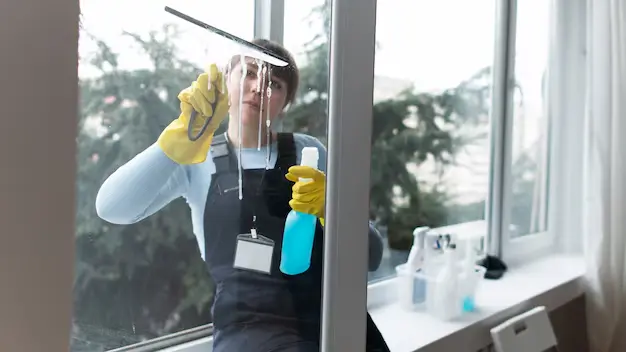
For everyday grime, an equal mix of white vinegar and distilled water in a spray bottle works well. The mild acidity cuts through light mineral film and the greasy residue that traffic pollution leaves on ground-floor glass.
Do not use vinegar or any ammonia-based cleaner on tinted or filmed glass. Avoid vinegar and ammonia-based cleaners on tinted or filmed glass, as they can damage the film or cause it to haze and lift. For these surfaces, use a pH-neutral glass cleaner and a soft microfiber cloth.
For tinted, filmed or coated glass, use a pH-neutral glass cleaner and a soft microfiber cloth instead. If you are unsure whether your windows are filmed, check the edge of the pane for a visible seam a few millimetres in from the frame.
5. Avoid Using Paper Towels
Paper towels tend to leave lint and streaks on windows. Instead, use a microfiber cloth or newspaper to wipe down the glass for a spotless finish.
Microfiber is the safer choice for a streak-free finish. Use one cloth for cleaning and a separate dry cloth for the final wipe, and avoid fabric softener when washing them because it can leave residue on the fibres.
6. Clean from Top to Bottom
To prevent dirty water from dripping onto already-cleaned areas, always start from the top and work your way down. This method ensures an even clean without streaks.
For large sliding doors and floor-to-ceiling glass, clean in overlapping horizontal sections from top to bottom, wiping the squeegee between passes.
7. Clear the Frames and Tracks First
This step is not cosmetic, and doing it in the wrong order is the most common way people damage their own windows.
Airborne sand in the UAE is largely quartz, which sits at roughly 7 on the Mohs hardness scale. Standard soda-lime window glass sits around 5.5. This is why understanding how dust and sand affect Dubai windows is important before cleaning heavily dusty glass. That difference is the whole problem: dragging a cloth across dusty, dry glass grinds sand particles into the surface and leaves fine scratches that no amount of cleaning will remove. The scratches then trap more dirt, and the glass looks permanently dull.
The correct sequence:
- Vacuum the tracks and frame recesses with a brush attachment dry, before any water touches the glass.
- Loosen compacted dirt in the corners with an old toothbrush or a stiff detailing brush.
- Rinse or wipe the frame down.
- Only then clean the glass, and pre-rinse it so loose sand floats off rather than being dragged across the surface.
While you are in the track, check the weep holes the small drainage slots along the bottom of the outer frame. When sand blocks them, rainwater and condensation sit against the seal and eventually stain the lower edge of the glass and corrode aluminium frames from the inside.
8. Use a Telescopic Pole for High Windows
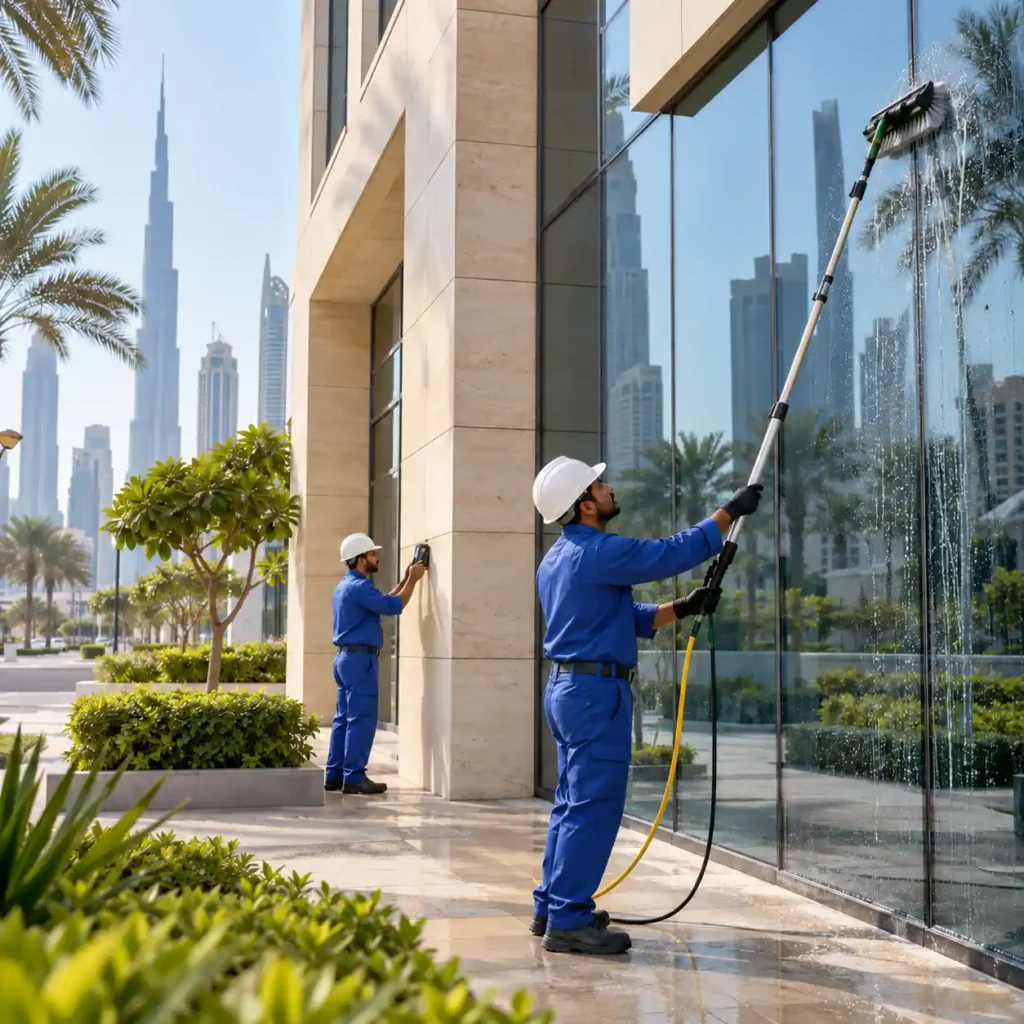
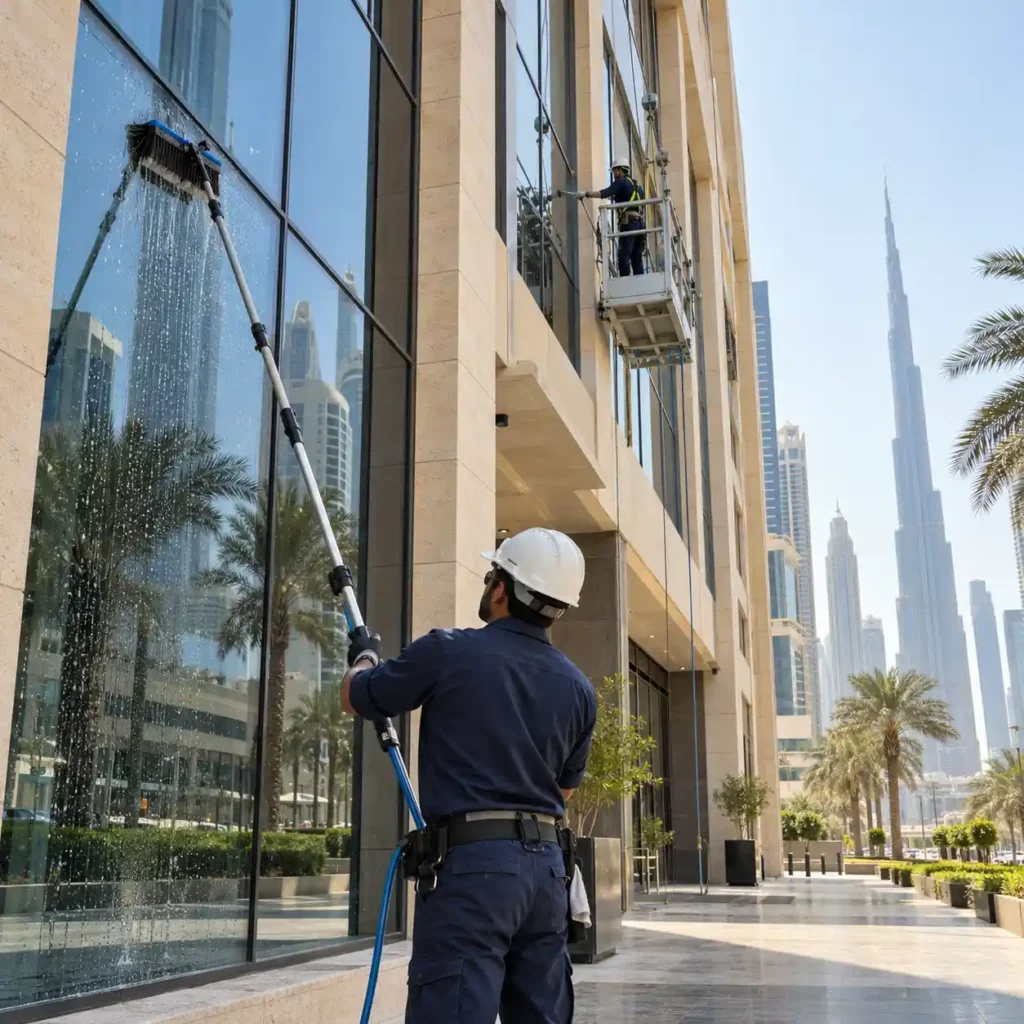
A telescopic pole with a squeegee or microfiber head lets you reach windows one storey above ground level without leaving the floor. For a villa’s first-floor exterior glass, or the upper panes of a double-height majlis, it is the right tool.
There is a hard limit to it, though. Every year people are seriously injured cleaning windows from balcony rails, window ledges and unsecured ladders. The rules worth treating as absolute:
- Never sit on, lean over, or climb through a window frame to reach exterior glass.
- Never stand on a balcony rail, air-conditioning unit, or planter.
- Never use a ladder on the sand, gravel or paving-joint surfaces common around Dubai villas without a stable, level base.
Above ground-floor level on an apartment or tower, exterior glass simply is not a DIY job external high-rise cleaning in Dubai requires licensed contractors working from approved access systems such as rope access, BMU cradles or certified powered platforms. Our guide to windows you genuinely cannot reach covers the safe options for each property type, including what works from inside for tilt-and-turn and pivot windows.
9. Consider Water-Repellent Coatings
A hydrophobic coating helps water bead and run off the glass instead of drying in place. This can reduce mineral spotting and make dust easier to rinse away between professional cleans.
What to know before spending money on it:
| Point | Detail |
|---|---|
| Typical lifespan | 6–24 months depending on product grade and sun exposure |
| Prep requirement | Glass must be completely clean and dry; a coating seals in whatever is underneath it |
| Won’t fix | Existing hard water etching. That must be removed first, or you lock the damage in |
| Best value on | South and west elevations, poolside glass, and any pane in a sprinkler’s arc |
Reapply on a schedule rather than waiting for performance to fail, because a partially worn coating cleans unevenly and looks worse than uncoated glass.
Quick Reference: What to Use and What to Avoid
| Situation | Use | Avoid |
|---|---|---|
| Everyday dust film | Distilled water + a drop of dish soap, microfiber, squeegee | Dry wiping |
| Light mineral spotting | 50/50 white vinegar and distilled water | Anything abrasive |
| Tinted or filmed glass | pH-neutral glass cleaner, soft microfiber | Vinegar, ammonia, scrapers |
| Heavy hard water staining | Professional restoration treatment | Repeated scrubbing, which spreads the etch |
| Cement or paint splatter | Professional removal | Metal blades on dry glass |
| Exterior glass above ground floor | Licensed access contractor | Ladders, ledges, balcony rails |
10. Hire Professional Window Cleaners for Best Results
Most residents can safely handle interior and ground-floor glass. Professional cleaning becomes the better choice when access is difficult, stains are stubborn, or the glass requires specialist products or equipment.
Call a professional when:
- The glass is above ground-floor level on the outside.
- White staining does not lift with vinegar that is etching, not dirt, and scrubbing makes it worse.
- There is cement splatter, paint overspray or silicone residue from construction or fit-out work.
- The glass is tinted, filmed or low-E coated and you are unsure what is safe to use on it.
- You are handing over or taking on a property and need the glass to pass an inspection.
For stubborn staining, post-construction residue, and coated or specialist panes, a proper glass cleaning in Dubai service uses restoration compounds and purified-water systems that are not practical to replicate at home, and works to a finish standard that a spray bottle cannot reach.
Trust Shafaf Cleaning for the Best Window Cleaning in Dubai
Shafaf Cleaning Services LLC has been cleaning glass across Dubai and Sharjah since 2014, including villas, apartments, retail frontage and high-rise towers. Our teams use purified-water systems, pH-appropriate products for coated and filmed glass, and certified rope access operatives for work at height.
If you need a one-off clean before a handover, a scheduled quarterly visit, or a full Building Cleaning in Dubai programme covering glass, facade and common areas, our window cleaning service in Dubai team can survey the property and quote against the actual access requirement rather than a flat rate.
Call +971 56 466 1546 or email info@shafafcleaning.ae for a same-day quotation.
Frequently Asked Questions
1. How often should windows be cleaned in Dubai?
For most homes and apartments, windows should be cleaned every 2 to 3 months. Properties exposed to construction dust, traffic, sand, or coastal humidity may need more frequent cleaning to prevent buildup and water stains.
2. How do I remove sand and dust from Dubai windows?
Avoid wiping dry, sandy glass because the particles can scratch the surface. Gently remove loose dust first, then clean the glass with water and a suitable cleaning solution before drying it with a clean squeegee.
3. What causes water stains on windows in Dubai?
Water stains are commonly caused by mineral deposits left behind when water evaporates. Regular cleaning and drying can help prevent buildup, while stubborn stains may require a specialist glass-cleaning solution.
4. Is it safe to clean high-rise windows myself?
Cleaning windows at height can be dangerous without the proper equipment, training, and fall-protection measures. High-rise windows are best handled by trained professionals using appropriate access and safety systems.
5. When should I hire professional window cleaning services in Dubai?
Professional window cleaning is recommended when windows are difficult to access, heavily stained, located at height, or require specialized equipment. Professionals can clean difficult areas more safely and efficiently while reducing the risk of glass or frame damage.
6. When is the best time to clean windows in Dubai?
Early morning, late afternoon, or another cooler period is generally preferable to cleaning glass under strong direct sunlight. Cooler conditions allow cleaning solutions to remain workable for longer and reduce streaking.