Some of the most expensive building damage in the UAE does not happen because of storms or major structural problems. It often starts with simple maintenance mistakes, such as using the wrong cleaning method, cleaning too infrequently, or choosing a method that does not suit the building material.
For example, using an acid-based glass cleaner near marble can damage the stone. Pressure-washing ACP panels can force water behind the edges, while cleaning a coastal building in Dubai only once a year may leave salt and other deposits to build up over time. These tasks may look like routine maintenance, but when they are done incorrectly or too late, they can affect building appearance and longevity.
These exterior maintenance mistakes are common across commercial and residential properties in Dubai and Sharjah. Professional building cleaning services in Dubai and Sharjah help identify maintenance issues early and protect exterior surfaces before they require expensive restoration.
Mistake 1: Wrong Chemistry for the Wrong Surface
This is the most consequential mistake and the most common. Different exterior materials have fundamentally different chemical tolerances. Using a product suitable for one material on an adjacent material causes damage that cleaning cannot reverse.
| Material | What Damages It | Visible Result |
|---|---|---|
| Marble, limestone, travertine | Acid-based products (common glass cleaners) | Permanent etching — matte or frosted patches on a polished surface |
| PVDF or polyester ACP coating | Bleach, high-pH alkaline products | Chalking — coating oxidises and transfers as pale powder |
| Anodised aluminium frames | Strong alkaline degreasers | White powdering as the anodic layer breaks down |
| Silicone and polyurethane sealants | Solvents, bleach, strong alkalis | Loss of flexibility and adhesion — active water ingress path |
| Low-E and tinted glass coatings | Abrasive pads, incompatible chemistry | Permanent hazing or loss of solar performance |
The root cause is treating building cleaning as a single-product operation. A commercial building with glass, ACP, stone, render, and sealant joints needs a different product for each substrate, not one solution diluted to whatever strength seems appropriate. A protective approach to exterior building materials helps reduce chemical damage and preserve surfaces during routine cleaning. This is especially important in the UAE, where heat, UV exposure, dust, and humidity can accelerate surface deterioration.
The same principle applies to maintenance planning. A preventive maintenance approach helps identify material deterioration early and reduces the need for more intensive cleaning or costly repairs later.
Mistake 2: High-Pressure Washing on Materials That Cannot Take It
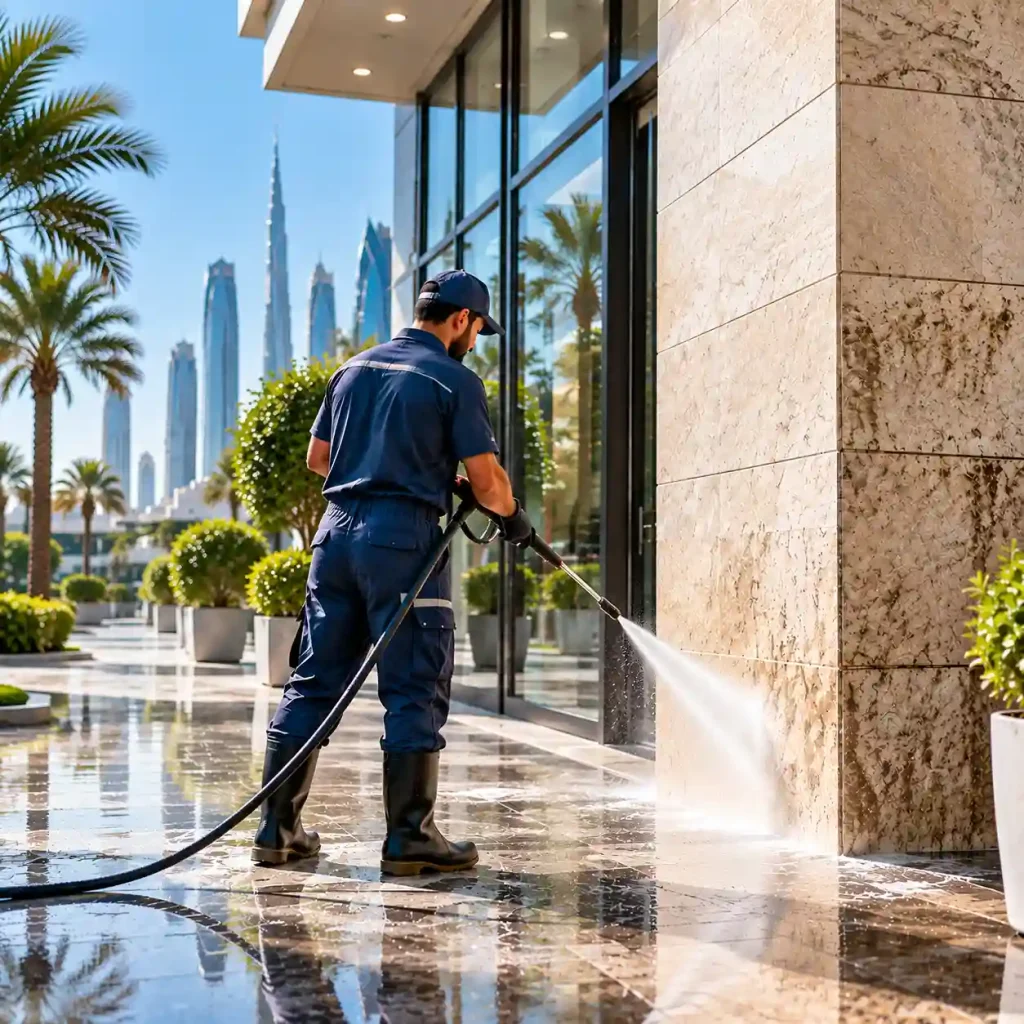
Pressure washing looks thorough. The contamination visibly lifts off the surface, and the building looks significantly better afterwards. This makes it a popular default — and a damaging one for most UAE facade materials.
What High-Pressure Water Actually Does
- On ACP panels: water forced in at panel edges penetrates between the aluminium skin and the polyethylene core. The bond weakens over repeated cycles. Eventually the panel edge lifts — a visible bubble or separation that requires panel replacement, not cleaning.
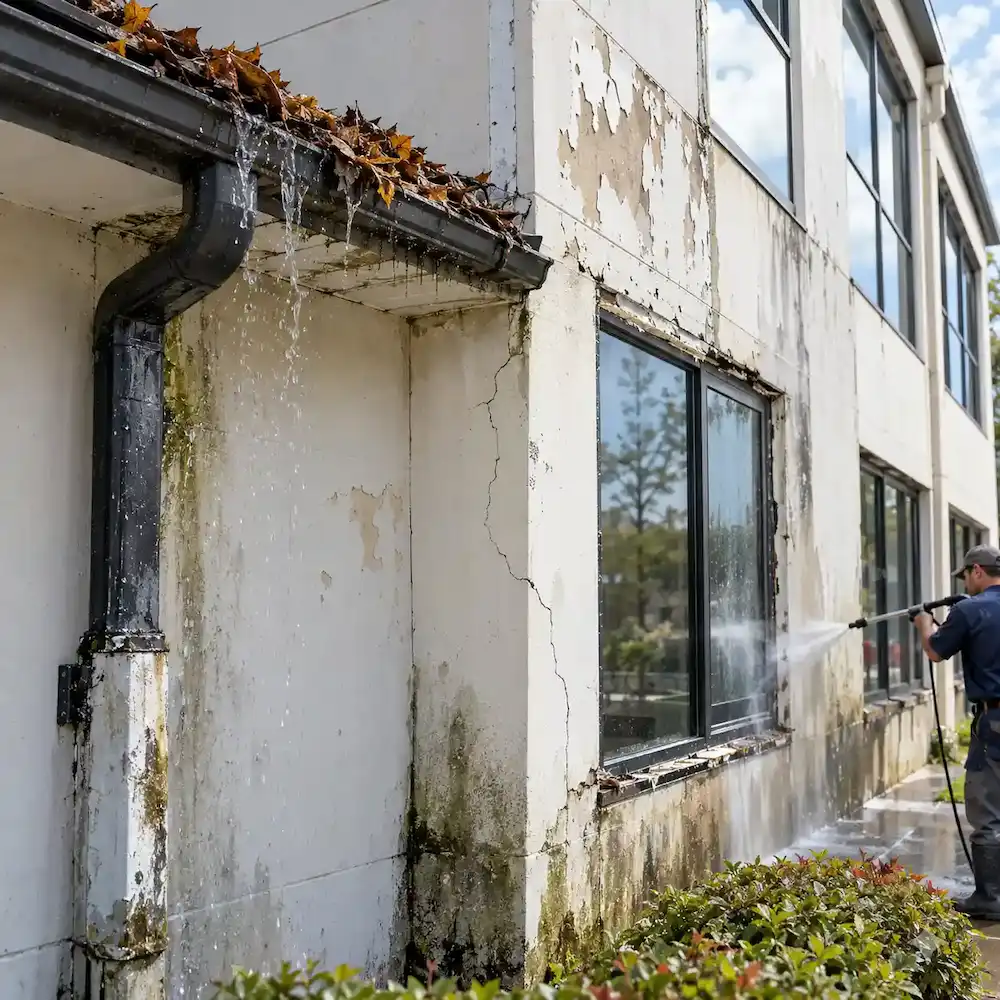
- On render: water driven into the render substrate at pressure creates a moisture layer behind the surface coat. In UAE temperatures, the surface dries fast but the substrate stays damp for days. Mould grows behind the paint film. The visible result is blistering and surface coat failure.
- On natural stone: stone with natural micro-fissures or grain lines can spall — lose surface fragments — when high-pressure water is introduced into those weaknesses. Affects sandstone, some limestone types, and older travertine used on lower facades.
- On sealant joints: high-pressure water undermines the sealant-to-substrate bond at the sealant edge. The sealant does not dislodge immediately, but the adhesion is progressively weakened, creating an early water ingress risk.
The correct alternative for all these materials is soft-washing — low-pressure water application with pre-treatment chemistry that dissolves contamination before the water is used. The chemistry does the work. The water rinses. No mechanical force required.
Mistake 3: Cleaning Intervals That Are Far Too Long
Annual cleaning is not a maintenance programme for a commercial building in Dubai or Sharjah. It is the minimum visible gesture of maintenance — and in the UAE environment, it is not even achieving that.
Here is what actually happens to a building exterior between annual cleans in the UAE:
- Months 1–2: surface dust accumulates. Still removable with water and mild chemistry.
- Months 2–4: Mineral deposits on glass begin chemical bonding with the surface. Biological growth starts in shaded zones. ACP contamination starts incorporating silica from the dust load. At this stage, regular glass cleaning in Dubai and Sharjah becomes important to remove deposits before they become more difficult to treat.
- Months 4–8: glass deposits progressing toward silicate bonding. Biological organisms established on stone and render — now require biocide treatment before removal. ACP contamination baked by summer UV into the coating surface.
- Months 8–12: restoration-grade chemistry required on glass. Significant biological staining on porous materials. Pressure required to shift contamination on ACP — increasing material damage risk. AC condensation staining in full view from the street.
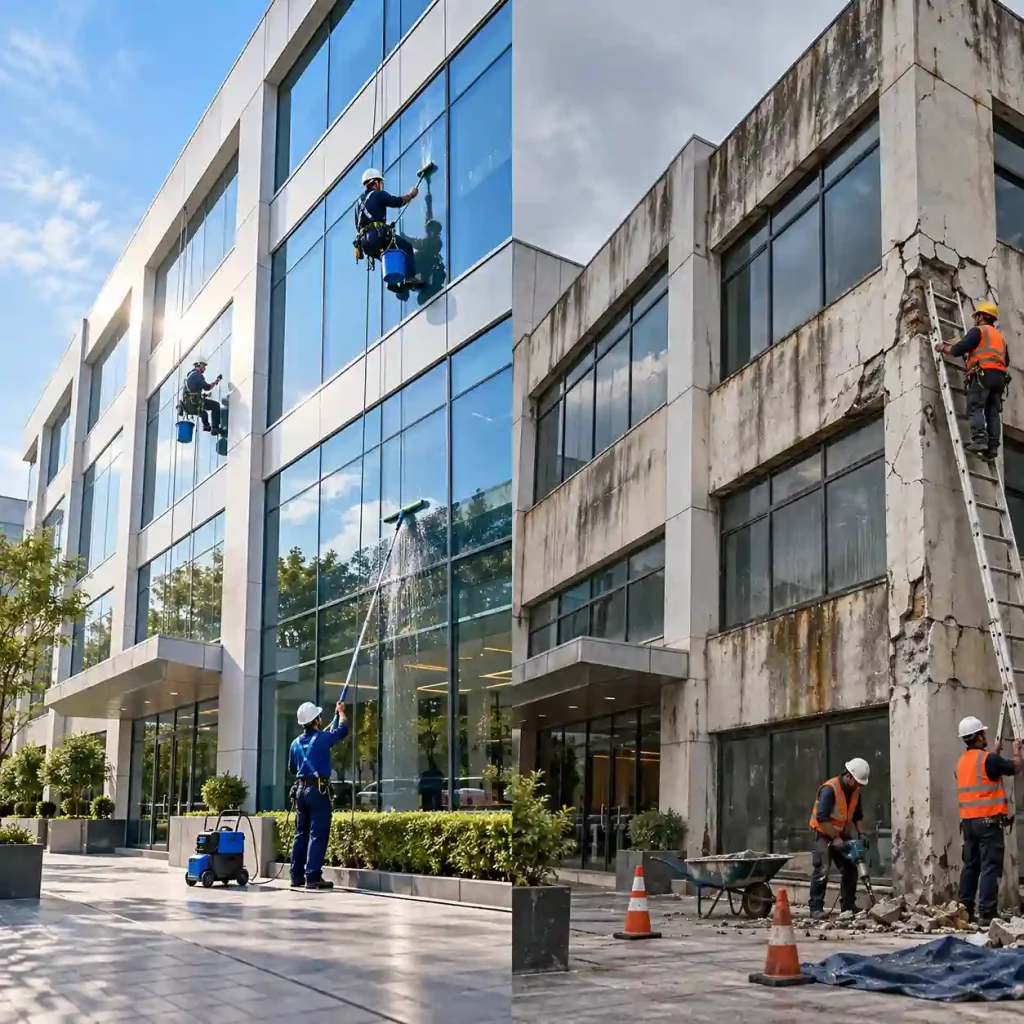
The annual clean that follows now requires more aggressive products, more labour time, higher equipment cost, and produces worse results — while also carrying a higher risk of material damage from the aggressive approach required. And the building has spent 10 months of the year looking neglected.
Buildings maintained quarterly need lighter chemistry, shorter visit times, and produce more consistent visual results than the same buildings maintained annually. The aggregate annual cost of quarterly cleaning is usually lower than the cost of a single annual restoration-grade clean — before accounting for any material damage the aggressive clean causes.
Mistake 4: Untrained Operatives on High-Level Access
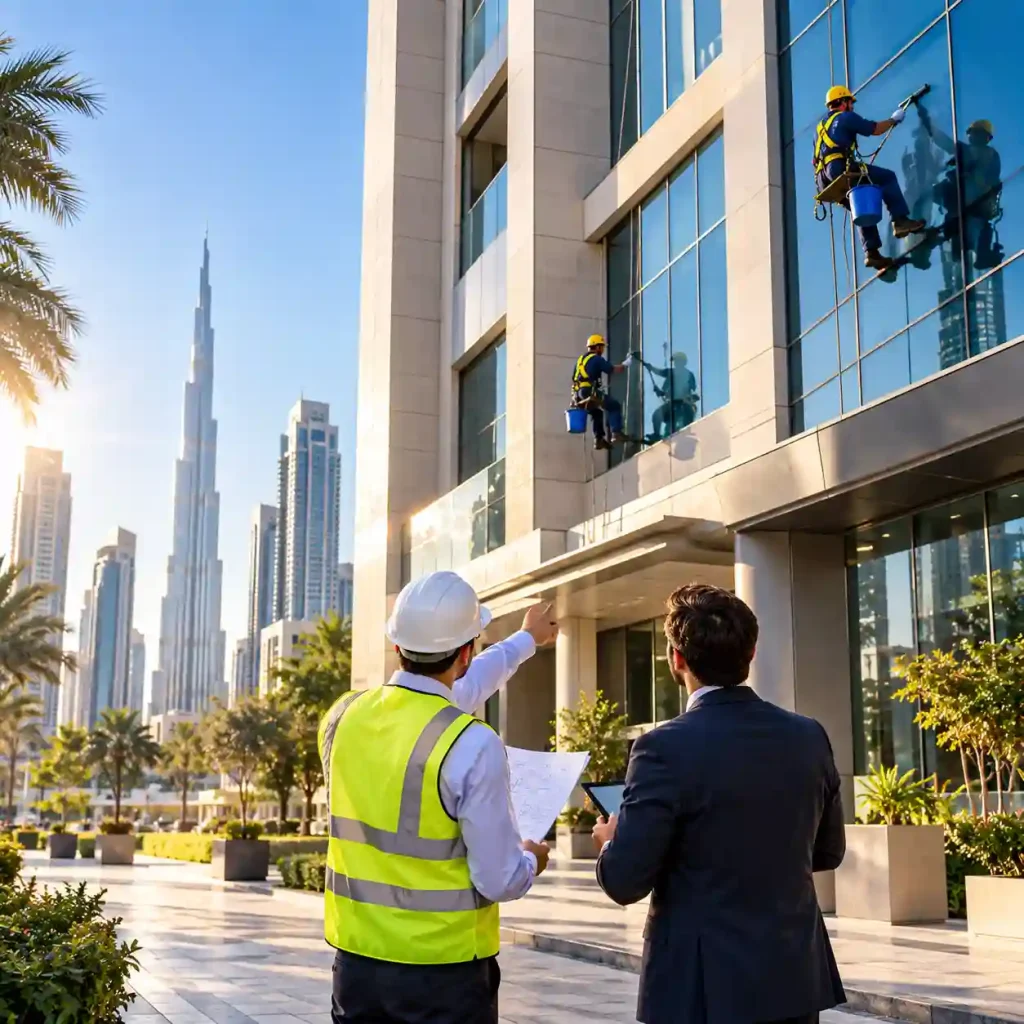
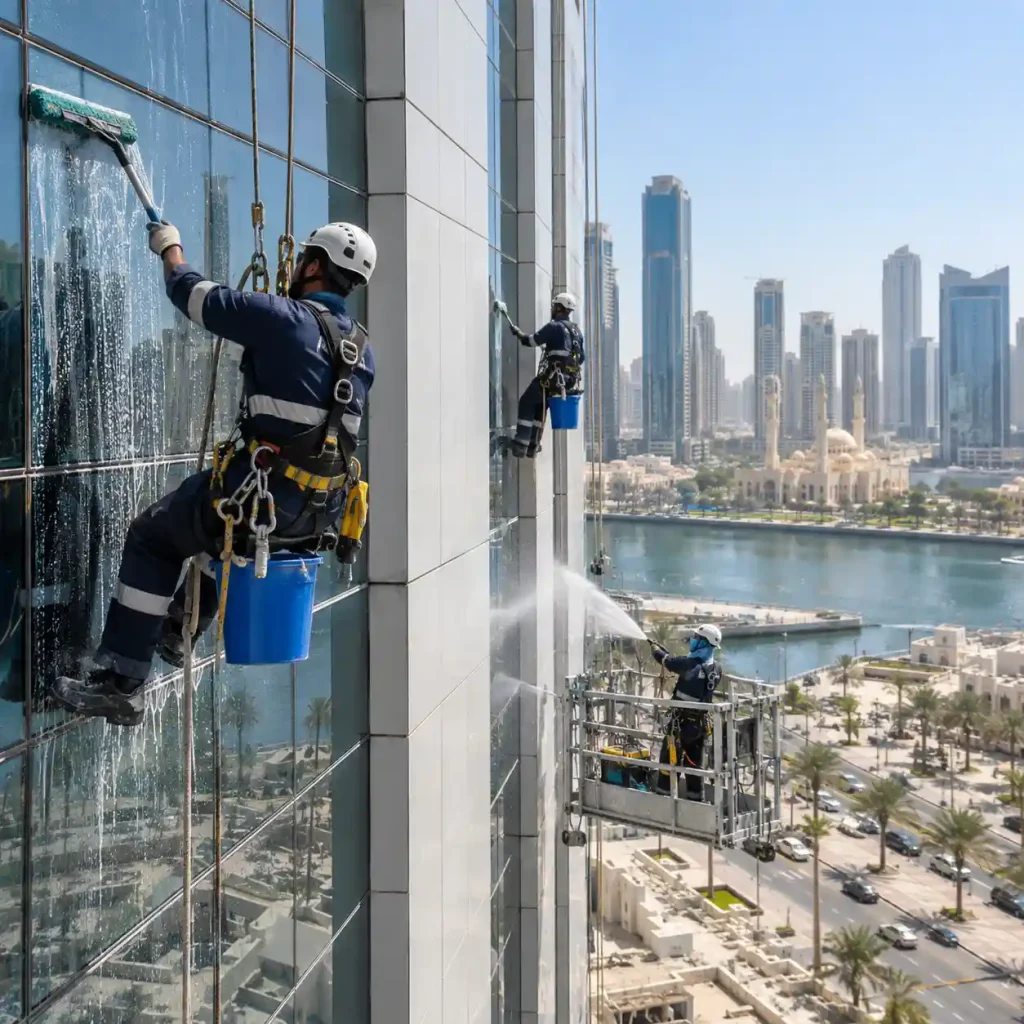
Working at height on a commercial building requires specific training, equipment, and competency. IRATA (Industrial Rope Access Trade Association) certification defines the professional standard for rope access work on UAE facades — Level 1 for supervised operatives, Level 2 for supervisors, Level 3 for planning and technical oversight.
Non-IRATA operatives on rope access or improvised cradle systems create two categories of problems:
- Safety risk: fall risk for the operative and falling object risk for people below. Building owners carry legal and financial liability for access incidents on their properties.
- Cleaning quality: untrained operatives compensate for technique deficiency with excessive product volume or water pressure, and consistently miss specific zones — column heads, re-entrant corners, the zones immediately below and above window frames — that require precise positioning to access correctly.
The uneven cleaning result — some zones clean, some zones missed, some zones over-chemically treated — is often more visually striking than no clean at all and can take months to even out as weather conditions gradually blend the treated and untreated surfaces.
Mistake 5: Missing the High-Risk Zones
A cleaning visit that covers the primary elevation surfaces but misses the zones where the most damaging contamination accumulates is not a complete clean. It is a cosmetic clean that leaves the actual maintenance problems untouched.
The zones most frequently missed, and where deterioration is most rapid:
- Below AC unit discharge points: condensate water from air conditioning carries biological matter, lubricants, and minerals. The dark vertical staining that forms below AC units is one of the most visible signs of neglect on UAE commercial buildings — and it is active, continuous contamination that reforms rapidly after cleaning if not addressed with the correct chemistry.
- Roof parapets and plant room surrounds: large volumes of dust accumulate on flat horizontal surfaces at roof level. During UAE rain events — rare but significant — this dust is mobilised and washes down the facade in concentrated flows, creating fresh staining on otherwise maintained lower elevations.
- Window frame perimeters: the junction between frame and glass, and between frame and wall, concentrates dust, insect residue, sealant degradation products, and biological staining. When these zones are not cleaned, they become the source of staining that spreads onto adjacent glass and cladding.
- Sealant joint lines: visually easy to overlook during a clean, but a condition inspection of sealant lines during a cleaning visit is the earliest possible point at which developing sealant failure can be identified and addressed before it causes water ingress.
Mistake 6: No Record of What Was Done or What Was Found
A cleaning visit that generates no documentation is a cleaning visit whose value disappears the moment the team drives away. The building management file has no record of what was cleaned, what condition the surfaces were in, or what developing issues were identified.
This matters for several reasons. Insurance and valuation purposes increasingly require documented maintenance records. Lease renewal negotiations benefit from evidence that the building has been consistently well-maintained. And most practically, identifying a sealant failure or cladding anomaly in one visit is only useful if it is communicated to the building manager in a form that results in action.
Professional facade cleaning services in Dubai and Sharjah should include a condition report after every visit — photographs, observations, and maintenance recommendations. This is the standard Shafaf Cleaning applies to every building we maintain.
The Pattern These Mistakes Create
None of these mistakes is catastrophic on its own, but they add up. A building where the wrong chemistry has been used for years, cleaning intervals are too long, high-risk areas are missed, and no inspection record exists can end up needing restoration instead of routine maintenance. Restoration is more than expensive cleaning. It can involve specialist chemistry at higher concentrations, mechanical intervention, longer visit times, and in some cases, replacement of materials such as etched stone or delaminated ACP.
Avoiding these mistakes also requires proper planning, not just scheduling. The building maintenance planning process explains how to structure an effective appearance management framework for commercial and residential buildings. A well-planned maintenance programme helps identify risks early, set appropriate cleaning intervals, and reduce the need for costly restoration later.
Conclusion:
Avoiding common exterior maintenance mistakes comes down to using the right methods, maintaining surfaces at suitable intervals, and addressing small issues before they become costly damage. Regular window cleaning in Dubai and Sharjah helps prevent stubborn deposits and surface damage, keeping glass clean and properly maintained for longer.
Frequently Asked Questions
Q: How do I know if my building has already been damaged by incorrect cleaning?
Common signs include matte or frosted stone, bubbling or lifted ACP edges, permanent glass haze, and blistering paint. These may indicate chemical damage, moisture ingress, mineral etching, or pressure-washing damage. A professional assessment is recommended before further cleaning.
Q: Is annual cleaning enough for commercial buildings in Dubai?
Usually, no. Dust, hard water, UV exposure, salt air, and AC condensate can cause exterior contamination to build up quickly. Cleaning frequency should be based on the building’s materials, location, exposure, and contamination levels.
Q: Why do AC condensation stains keep coming back even after cleaning?
Because the AC condensate continues to discharge onto the facade after cleaning. Regular cleaning can control the staining, but proper condensate drainage should also be addressed to prevent repeated marks on glass, stone, or ACP surfaces.
Q: What should a professional building cleaning contract include?
It should specify the cleaning products and methods for each material, access methods, cleaning frequency, inspection requirements, and post-cleaning reporting. It should also define how any maintenance or damage issues identified during cleaning will be handled.