Most building maintenance problems do not begin when visible damage appears. They begin months earlier, when dust, mineral deposits, biological growth, and environmental contamination are allowed to remain on exterior surfaces.
For commercial properties in Dubai and Sharjah, delaying facade maintenance can turn a relatively simple cleaning programme into a much more expensive restoration project.
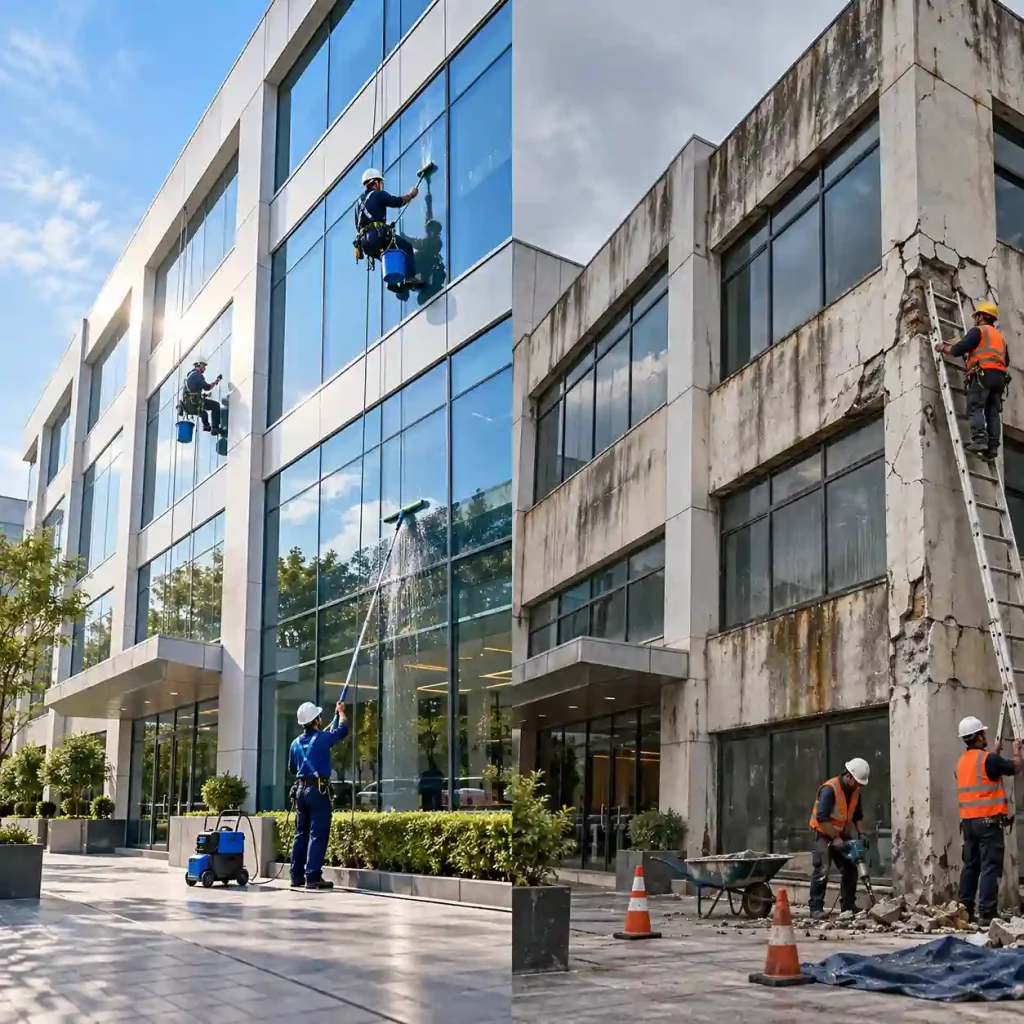
Preventive building cleaning focuses on removing contamination before it bonds with glass, aluminium composite panels, stone and other facade materials. Reactive maintenance begins after staining, surface deterioration or material damage has already become visible.
The financial difference can be substantial. A scheduled cleaning programme may cost tens of thousands of dirhams over several years, while prolonged neglect can lead to restoration or replacement costs reaching hundreds of thousands of dirhams.
Regular exterior maintenance can also help preserve building appearance and property value by preventing visible deterioration from developing in the first place.
How Contamination Compounds Over Time
The chemistry of surface contamination in the UAE environment is not linear. There are distinct stages, and crossing from one stage to the next changes both the removal method required and the risk of permanent substrate damage.
Stage 1: Surface Contamination (Weeks 1–4)
Fresh dust, recent mineral deposits, and early biological spores on the surface. Removable with water and mild chemistry. Risk of material damage during cleaning: low.
Stage 2: Early Bonding (Months 1–3)
Mineral deposits begin chemical bonding with glass and stone surfaces. Biological organisms are establishing. Silica from UAE dust starts to incorporate into the ACP contamination layer. Mild acidic chemistry is needed for glass. Biocide pre-treatment required before biological removal. Risk of material damage: low to moderate with correct products.
Stage 3: Established Contamination (Months 3–8)
Glass mineral deposits progressing toward silicate bonding — moving from being on the surface to being in it. Biological colonies active and spreading to new areas. ACP contamination baked by UAE summer UV into the coating. Restoration-grade chemistry required on glass. Pressure may be needed on ACP. Risk of material damage: moderate to high.
Stage 4: Embedded Damage (Beyond 8 Months)
Glass etching may be irreversible through chemistry alone. Established biological staining has penetrated porous materials. ACP coating may require restoration rather than cleaning. Deferred sealant issues may have allowed water ingress. Cost: restoration project, not maintenance.
This progression is why the cost of removal is not proportional to the time since the last clean. A surface cleaned at Stage 1 costs far less to maintain than the same surface addressed at Stage 3 — and Stage 4 may involve costs that exceed the value of the cleaning contract itself.
Preventive Cleaning vs Reactive Maintenance Cost Comparison
For mid-rise commercial buildings in Dubai and Sharjah, the difference between preventive and reactive maintenance can become substantial over several years.
| Maintenance Approach | Cost per Year | 3-Year Total | Additional Risk |
|---|---|---|---|
| Quarterly professional cleaning | AED 18,000 – 35,000 | AED 54,000 – 105,000 | Minimal — contamination never reaches the bonding stage |
| Annual reactive cleaning | AED 40,000 – 80,000 | AED 120,000 – 240,000 | Moderate — aggressive chemistry needed; some material damage risk |
| Deferred 2+ years then restored | No annual cost | AED 150,000 – 500,000+ | High — restoration required; material damage likely; may trigger partial replacement |
| Material remediation or replacement | N/A | AED 80,000 – 800,000+ | Damage already done — cost is remediation only |
These figures are indicative ranges for mid-rise commercial buildings of approximately 10–20 floors with mixed glass and ACP cladding. Actual pricing depends on building height, facade condition, access requirements, contamination level, and material type.
The reactive approach does not simply cost more. It also creates compounding risks: tenant perception damage during the deterioration period, potential valuation impacts, insurance liability exposure if material failures create safety risks, and the disruption cost of restoration projects on occupied buildings.
Preventive Cleaning vs Restoration Disruption
Preventive cleaning generally requires less time and infrastructure than major restoration work.
A scheduled cleaning visit for a mid-rise commercial property may often be completed within one or two days.
Restoration work after prolonged neglect can take considerably longer and may require:
- Scaffolding
- Rope-access teams
- Mobile elevated platforms
- Restricted access areas
- Extended safety controls
- Multiple restoration stages
Longer projects may also affect office occupants, retail tenants and visitors.
How Preventive Cleaning Supports Tenant Experience
The facade is one of the most visible indicators of how a commercial property is maintained.
A consistent exterior cleaning schedule helps prevent dirt, staining and deterioration from becoming prominent enough to affect the appearance of the property.
For landlords and property managers, this may support a more professional building image while reducing the likelihood of large restorative projects later.
Learn more about the relationship between exterior condition and protecting commercial property value.
What a Preventive Building Cleaning Programme Should Include
A structured exterior maintenance programme should consider the building’s materials, height, exposure and previous maintenance history.
Cleaning Frequency Based on Exposure
Recommended cleaning intervals may vary by area:
- Entrance glass and ground-level areas: every 2–4 weeks
- Mid-rise glazing and ACP: every 6–10 weeks
- High-rise curtain walls: every 8–12 weeks
- Stone and rendered surfaces: every 8–12 weeks where required
Actual frequency should be determined after inspecting the property.
Material-Specific Cleaning Methods
Different facade materials require different cleaning products and techniques.
A cleaning programme should account for surfaces such as:
- Glass
- Aluminium composite panels
- Natural stone
- Render
- Coated glass
- Metal cladding
Using unsuitable cleaning chemicals can increase the risk of staining, coating damage or surface deterioration.
Appropriate Access Methods
Cleaning access should be selected according to the height and configuration of the building.
This may include:
- Ground-based cleaning systems
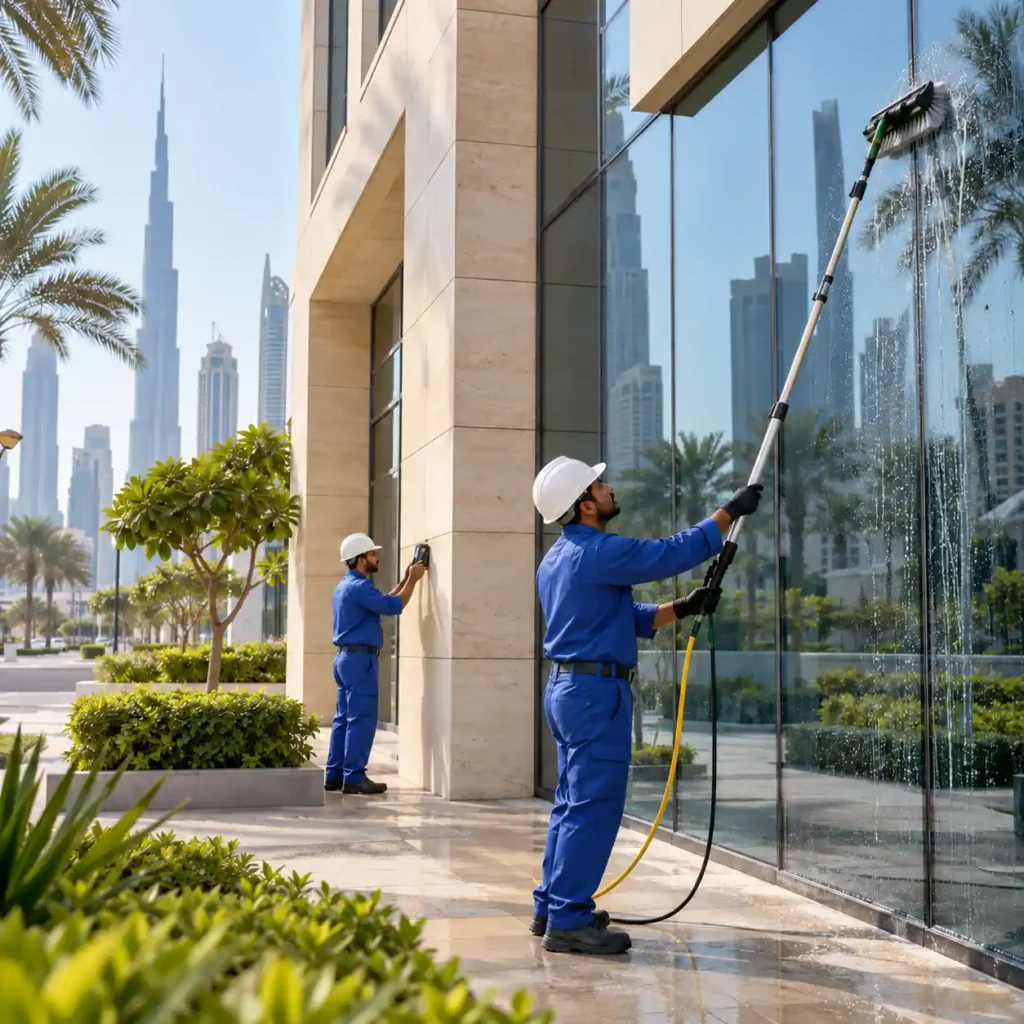
- Extension equipment
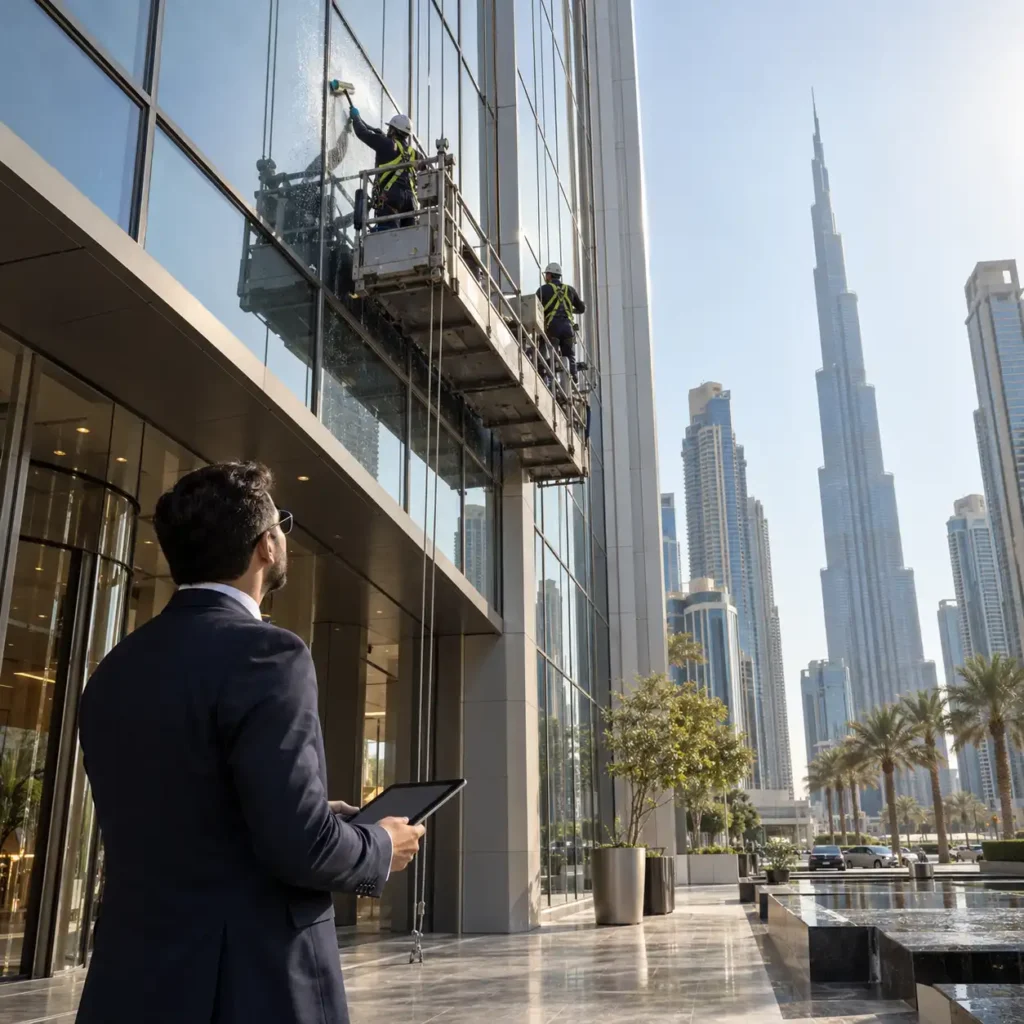
- Mobile elevated work platforms
- Cradle systems
- IRATA-certified rope access
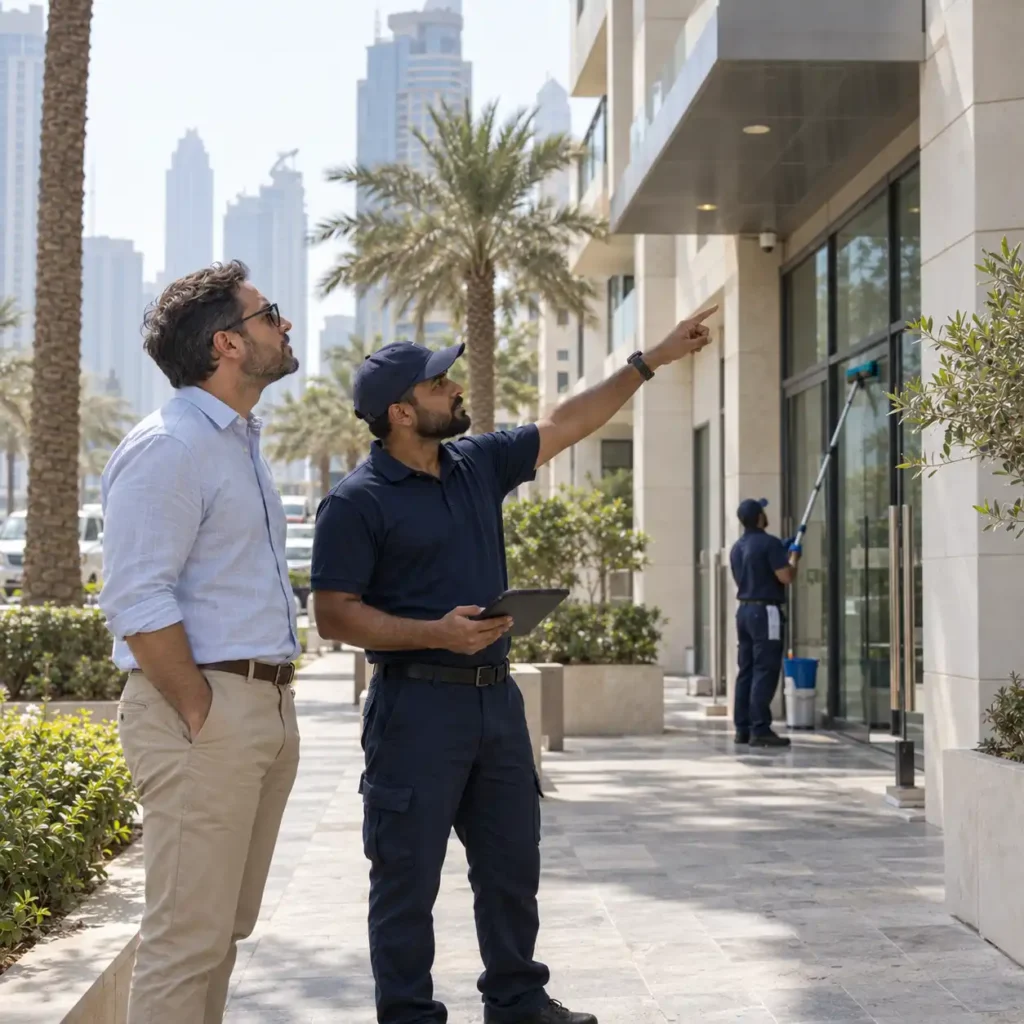
Post-Cleaning Inspection
Each scheduled visit should ideally include:
- Condition photographs
- Surface observations
- Signs of deterioration
- Sealant observations
- Maintenance recommendations
This creates an early-warning system for problems that may otherwise become expensive restoration work.
Avoiding costly exterior maintenance mistakes can further improve the long-term performance of the maintenance programme.
For a broader planning framework, read our guide to strategic building appearance management.
Preventive Building Cleaning Services in Dubai and Sharjah
Shafaf Cleaning provides building cleaning services in Dubai and Sharjah for commercial and residential properties.
Cleaning programmes can be planned around:
- Building height
- Exterior materials
- Current facade condition
- Access requirements
- Previous maintenance history
- Required cleaning frequency
For buildings with extensive glazing, professional window cleaning in Dubai and Sharjah can be arranged as a standalone service or incorporated into a wider exterior maintenance programme.
Frequently Asked Questions
Is preventive building cleaning cheaper than reactive maintenance?
Preventive cleaning can reduce long-term maintenance costs because contamination is removed before it becomes heavily bonded to facade materials. Reactive cleaning may require stronger chemicals, additional labour, or restoration work.
How much does preventive building cleaning cost in Dubai?
For a mid-rise commercial building, indicative annual preventive cleaning costs may range from AED 18,000 to AED 35,000. Actual costs depend on building size, height, access, materials, and cleaning frequency.
How much can reactive facade maintenance cost?
Reactive cleaning may range from approximately AED 40,000 to AED 80,000 annually for some mid-rise commercial properties. Restoration after prolonged neglect can be significantly more expensive.
How often should a commercial building facade be cleaned?
Cleaning frequency depends on material type, building location, and environmental exposure. Some high-visibility areas may require cleaning every few weeks, while larger facade areas may follow an 8–12 week schedule.
Can a building move from reactive to preventive maintenance?
Yes. A building with existing contamination may first require a deep clean or restoration treatment. After the facade has been stabilised, a scheduled preventive programme can be introduced.
Does every cleaning visit need to cover the entire building?
No. High-visibility or high-exposure areas can be cleaned more frequently while complete facade cleaning follows a different schedule.